Fixed-fee pricing
Get your carbon assessment quote
View pricing →Table of Contents
ISO 14068 is the first international standard for carbon neutrality. Published in November 2023, it provides a credible framework for organisations to achieve, demonstrate, and communicate carbon neutrality.
The full title is "ISO 14068-1: Climate change management, Transition to net zero, Part 1: Carbon neutrality". Unlike a formal ISO 14068 certification you "pass", it is a framework that verification bodies assess your alignment against.
For businesses making carbon neutral claims, ISO 14068 provides the international credibility that regulators and stakeholders increasingly expect. It is particularly relevant for organisations bidding for public sector contracts where carbon credentials are scrutinised.
If you want help reaching it, The Carbon Stamp runs carbon neutral certification aligned with ISO 14068 for UK SMEs, measure, reduce, then offset the residual with verified credits.
ISO 14068 Requirements: The Five Core Pillars
ISO 14068 certification requires businesses to meet clear standards for achieving credible carbon neutral certification. Here are the five core pillars in plain language:
- Quantification, Measure All Emissions: You must measure all Scope 1 (direct), Scope 2 (electricity), and material Scope 3 (supply chain) emissions using the GHG Protocol Corporate Standard. The boundary must be clearly defined and justified.
- Reduction Plans, Demonstrate Commitment: You must have a documented carbon reduction plan showing how you will reduce emissions over time. ISO 14068 emphasises that offsetting should not replace reduction efforts. A trajectory towards lower emissions is required.
- Offset Quality, Use Verified Credits Only: Any emissions you offset must use credits from recognised registries such as Gold Standard, Verra (VCS), or UN CER. Credits must meet additionality, permanence, and verification requirements. Learn more about verified carbon offsetting and how to source credible offsets.
- Transparency, Public Disclosure Required: You must publicly disclose your carbon footprint, reduction targets, offset project details, and any limitations to your claim. This transparency requirement helps prevent greenwashing.
- Time-Bound Claims, Specify the Period: Carbon neutrality claims must specify the time period covered (e.g., "Carbon neutral for 2025"). Claims cannot be indefinite, they relate to a specific reporting period with matching offsets.
ISO 14068 vs PAS 2060: Which Should You Use?
Both standards provide frameworks for carbon neutrality, but there are key differences businesses should understand.
| Aspect | ISO 14068 | PAS 2060 |
|---|---|---|
| Status | International ISO Standard (2023) | British Standard (2010, updated 2014) |
| Geographic Scope | Global recognition | Primarily UK-focused |
| Reduction Emphasis | Strong, requires reduction trajectory | Present but less prescriptive |
| Net Zero Integration | Explicit, Part 1 of net zero series | Carbon neutrality only |
| Best For | International credibility, future-proofing | Current compliance, existing PAS 2060 holders |
Our recommendation: For new carbon neutrality programmes, we recommend ISO 14068 alignment. It provides greater international credibility and is explicitly designed for the transition to Net Zero. Existing PAS 2060 holders can transition to ISO 14068 over time.
Who Needs ISO 14068 Certification? Key Industries and Use Cases
ISO 14068 carbon neutral certification is particularly valuable for:
- Public sector suppliers: Businesses bidding for government contracts where Carbon Reduction Plans are required. ISO 14068 demonstrates credible carbon action beyond basic compliance. Suppliers can also benefit from a formal Carbon Reduction Plan service to meet tender requirements.
- Corporate supply chains: Suppliers to large corporates with Net Zero commitments. Many corporates now require supply chain carbon neutrality evidence as part of their Scope 3 reduction strategies.
- Marketing claims: Businesses making carbon neutral claims to customers. Regulators increasingly scrutinise green claims, ISO 14068 provides defensible evidence.
- Competitive differentiation: Organisations wanting to stand out on sustainability. ISO 14068 is still emerging, early adopters gain competitive advantage before it becomes table stakes.
Case Study: Medicom Healthcare
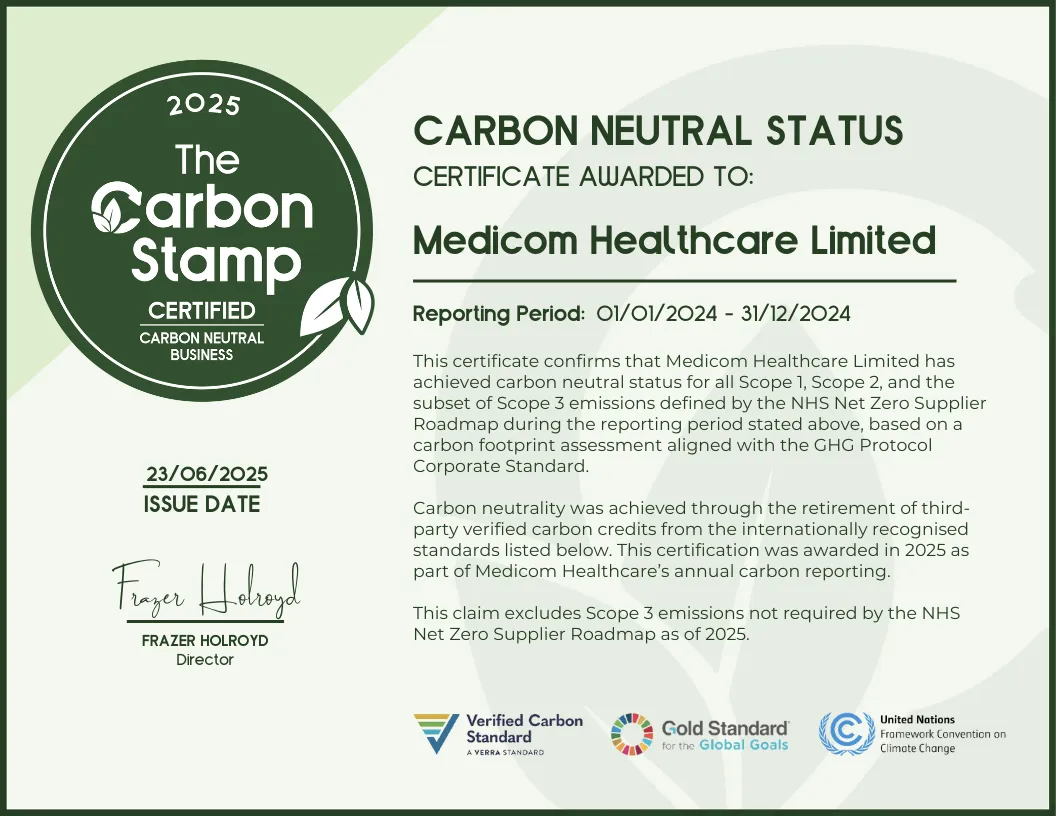
Medicom Healthcare, an NHS supplier of medical devices, achieved carbon neutrality in alignment with ISO 14068. Working with The Carbon Stamp, they measured their full carbon footprint across Scope 1, 2, and 3 emissions, implemented targeted reduction measures, and offset residual emissions with Gold Standard and Verra verified credits.
Carbon Neutral Certification Options Compared
Businesses seeking carbon neutral certification have several options. Understanding the differences helps you choose the right approach for your organisation's needs and credibility requirements.
| Certification Option | Recognition | Verification Required | Best For |
|---|---|---|---|
| ISO 14068 | International (ISO) | Third-party recommended | International credibility, procurement |
| PAS 2060 | British Standard (BSI) | Self-declaration or third-party | Existing holders, UK-focused |
| CarbonNeutral Protocol | Private (South Pole) | Provider verification | Marketing-focused claims |
| Self-Declared Claims | None | None required | Not recommended, greenwashing risk |
Note: For businesses seeking credible carbon neutral certification, ISO 14068 offers the strongest international recognition and future-proofing. It positions carbon neutrality as part of a transition to Net Zero, which aligns with regulatory and stakeholder expectations.
Carbon Neutral Certification in the UK: What Applies Here
If you are searching for carbon neutral certification UK, the practical question is which route gives a UK business a claim that buyers and regulators will accept. There is no single government-run "carbon neutral" certificate. UK organisations instead choose between an international standard (ISO 14068), the older British Standard (PAS 2060), and a range of private schemes, set side by side in the two tables above.
For most UK SMEs the decision comes down to where the claim will be used. ISO 14068 carries international recognition and suits suppliers to large corporates or overseas customers. PAS 2060 stays familiar to UK buyers and is a reasonable fit for organisations already holding it, though it is expected to give way to ISO 14068 over time. Private "carbon neutral" schemes can be quicker, but they vary widely in how much independent verification sits behind them, so the credibility of the badge depends on the provider.
UK public sector suppliers should note that certification is separate from the mandatory Carbon Reduction Plan required under PPN 006. The Carbon Reduction Plan is the tender requirement; carbon neutral certification is an extra, voluntary credibility signal on top of it. Whichever route you take, the groundwork is the same: a measured footprint, a genuine reduction plan, and verified offsets for what remains.
How to Achieve ISO 14068 Carbon Neutrality
Here is the step-by-step process for achieving ISO 14068 aligned carbon neutrality. Many businesses engage specialist ISO 14068 consultancy to accelerate this process and ensure compliance:
- Measure Your Carbon Footprint: Calculate Scope 1, 2, and material Scope 3 emissions using the GHG Protocol. This forms the baseline for your carbon neutrality claim. Professional carbon consultancy ensures accuracy.
- Develop a Carbon Reduction Plan: Create a documented plan showing how you will reduce emissions over time. Include specific targets, timelines, and actions. This demonstrates the reduction commitment ISO 14068 requires.
- Implement Reduction Measures: Take action on your reduction plan. Energy efficiency, renewable energy procurement, supply chain engagement, and operational changes all contribute to genuine emission reductions.
- Offset Residual Emissions: Purchase verified carbon credits from recognised registries (Gold Standard, Verra, UN CER) to balance remaining emissions. Quality offset sourcing is essential for credibility.
- Document and Disclose: Prepare comprehensive documentation including your carbon footprint, reduction plan, offset details, and statement of carbon neutrality. Public disclosure is required.
- Obtain Third-Party Verification: Engage an accredited verification body to assess your ISO 14068 alignment. Verification provides independent assurance and strengthens the credibility of your carbon neutral claim.
For SMEs, the measurement prerequisite, a Scope 1, 2 and material Scope 3 baseline aligned with ISO 14064, is delivered through The Carbon Stamp's Carbon Impact Report, which ranges from £1,295 to £3,995+VAT as a one-off fee for businesses with 3–250 employees. The offsetting step required by ISO 14068-1 is met using verified Gold Standard or Verra VCS credits, which The Carbon Stamp sources at £6.50/tCO₂e+VAT; Ecosystem Marketplace's State of the Voluntary Carbon Market shows verified credits typically trading between roughly £3 and £40 per tonne CO₂e across registries and project types.
ISO 14068 Verification Bodies
Several accredited bodies can verify ISO 14068 alignment:
- SGS: Global verification leader offering ISO 14068-1 verification services.
- BSI (British Standards Institution): Strong PAS 2060 heritage transitioning to ISO 14068.
- Bureau Veritas: International verification presence.
- LRQA (Lloyd's Register): Established verification body for environmental standards.
When selecting a verification body, check their UKAS accreditation status to ensure they meet internationally recognised competence standards. For how accredited verification differs from the quality checks a consultant carries out, see carbon footprint verification vs assurance.
Important distinction: Verification confirms alignment with ISO 14068 certification requirements. It differs from certification (which implies passing a formal assessment). Most organisations pursue "verified alignment" or "conformity" rather than formal certification.
ISO 14068 for Procurement and Supply Chains
ISO 14068 is increasingly referenced in procurement processes as buyers seek credible evidence of supplier carbon action. Understanding how to use ISO 14068 in procurement can strengthen tender responses and open up new contract opportunities.
Public Sector Procurement
Government contracts above £5 million require Carbon Reduction Plans under PPN 006. While ISO 14068 is not mandated, demonstrating ISO 14068 alignment provides additional credibility beyond basic compliance. Buyers increasingly value suppliers who go beyond minimum requirements.
Corporate Supply Chain Requirements
Large corporates with Net Zero commitments are engaging suppliers to reduce Scope 3 emissions. ISO 14068 carbon neutral certification provides independent evidence that suppliers are taking credible climate action. This is particularly relevant for suppliers to FTSE 100 companies, multinational retailers, and organisations with science-based targets.
How ISO 14068 Strengthens Tender Responses
- Credibility: ISO 14068 alignment demonstrates commitment to internationally recognised standards, not self-declared claims.
- Transparency: The standard requires public disclosure of emissions, reduction plans, and offset details, providing evidence buyers can verify.
- Reduction trajectory: ISO 14068 emphasises ongoing emission reductions, not just offsetting, aligning with buyer expectations for genuine climate action.
Note: Businesses pursuing both ISO 14068 and PPN 06/21 compliance can benefit from ISO 14068 consultancy that integrates both requirements into a single engagement.
Frequently Asked Questions
Interested in ISO 14068-1 carbon neutral certification?
The Carbon Stamp provides expert carbon consultancy for UK businesses, from carbon footprinting to Carbon Reduction Plans, SECR reporting and ISO 14068 certification.