Fixed fee, 2 to 4 weeks
Need a compliant PPN 006 plan?
See pricing →Table of Contents

Written by Frazer Holroyd, Carbon Reduction Plan Specialist and Founder of The Carbon Stamp.
If you're bidding for UK government or NHS contracts and wondering what PPN 006 means for your business, you're in the right place. This policy can feel complex at first, but we'll break it down into clear, practical terms.
Whether you're an SME applying for your first major tender, an established supplier updating your compliance approach, or simply trying to understand what's required, this guide covers everything you need to know about PPN 006 (originally published as PPN 06/21 in 2021 and renamed in February 2025).
This guide covers:
- Who must comply with PPN 006 and the £5 million threshold
- The 7 requirements for a compliant Carbon Reduction Plan
- How to handle Scope 3 emissions (without reporting all 15 categories)
- Common mistakes that lead to tender rejection, and how to avoid them
Working to a tender deadline?
You do not have to read all of this first. Take the free template and get started, or have us produce the whole plan for a fixed fee, typically in 2 to 4 weeks.
What Is PPN 006?
PPN 006 (Procurement Policy Note 006) is the UK government policy requiring suppliers bidding for major government contracts to demonstrate their commitment to achieving Net Zero greenhouse gas emissions by 2050. It was originally introduced by the Cabinet Office in June 2021 as PPN 06/21 and renamed to PPN 006 in February 2025 under the Procurement Act 2023.
The policy uses public procurement as a lever to drive carbon reduction across the UK economy. By requiring suppliers to submit a Carbon Reduction Plan, the government ensures that organisations receiving public money are actively working to reduce their environmental impact.
For the official guidance, see the original gov.uk PPN 06/21 publication, which remains the underlying technical reference for PPN 006.
Key takeaway: PPN 006 is mandatory, not voluntary. No compliant Carbon Reduction Plan means automatic exclusion from the procurement process.
For a section-by-section breakdown of the structure of a compliant PPN 006 CRP, see our dedicated explainer.
Why Carbon Reduction Plans Matter
Beyond compliance, a well-executed Carbon Reduction Plan delivers real business benefits:
- Win more contracts: A CRP is now table stakes for public sector work. Without one, you're excluded before evaluation begins.
- Identify cost savings: Emissions measurement often reveals operational inefficiencies. Many clients reduce energy costs after their first carbon audit.
- Build reputation and trust: A CRP demonstrates genuine environmental commitment to clients, partners, and stakeholders.
- Future-proof your business: Requirements are expanding, NHS 2024, Scope 3 expansion 2027. Getting ahead now avoids last-minute scrambles.
- Boost employee engagement: Sustainability initiatives improve morale and help attract talent who want to work for environmentally responsible organisations.
Who Does PPN 006 Apply To?
Any business, regardless of size, that bids for public sector contracts over £5 million annually. The threshold is based on contract value, not company size. Examples include construction firms tendering for National Highways, medical suppliers bidding for NHS frameworks, or IT providers applying for central government work.
Note for NHS suppliers: From April 2024, the NHS extended requirements to all new procurements, not just those over £5 million. See our dedicated PPN 006 NHS supplier requirements guide for specific compliance steps.
For construction companies: The construction sector faces unique challenges with embodied carbon and subcontractor Scope 3 emissions. Our PPN 006 construction CRP guidance covers National Highways requirements and sector-specific approaches.
Beyond public sector: Larger private companies are increasingly requesting CRPs from key suppliers as part of their own Net Zero commitments. See how Addis Housewares met retail partner sustainability requirements and ACP achieved ISO 14068-aligned carbon neutrality.
"This was our first experience with the PPN 006 Carbon Reduction Plan, and The Carbon Stamp supported us every step of the way. They helped us understand the requirements clearly, allowing us to provide the necessary data quickly and efficiently."
- Medicom Healthcare, NHS Supplier
If you are bidding for public sector work, you need a Carbon Reduction Plan. See our guides on how to create a compliant Carbon Reduction Plan and construction-specific guidance covering subcontractor emissions and embodied carbon.
What Are the PPN 006 Requirements?
A compliant Carbon Reduction Plan under PPN 006 must include:
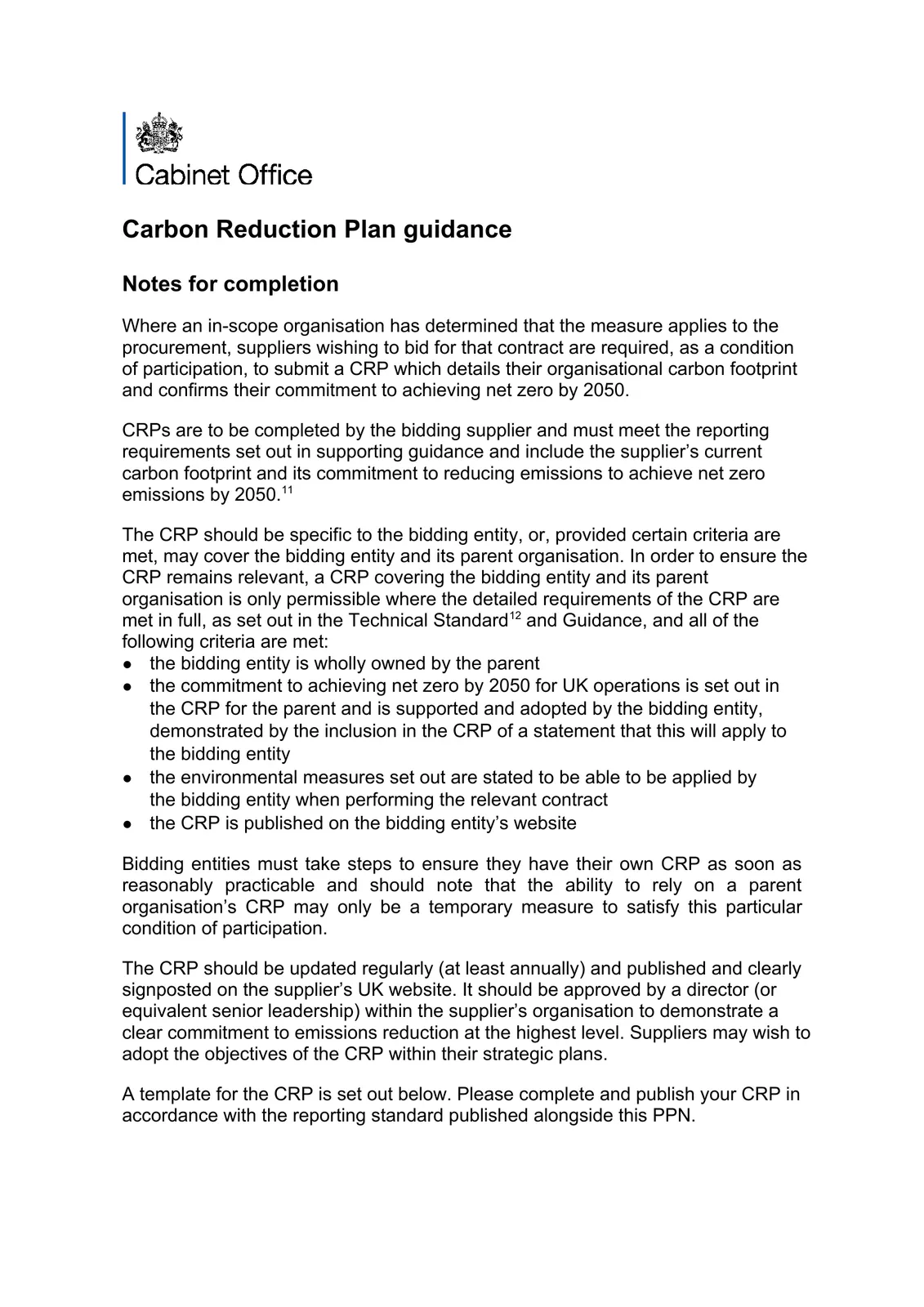
- Net Zero commitment by 2050: A formal statement confirming your organisation's commitment to achieving Net Zero greenhouse gas emissions by 2050 or earlier.
- Scope 1 and Scope 2 emissions: Complete reporting of your direct emissions (Scope 1) and purchased electricity, heat, and steam (Scope 2).
- Relevant Scope 3 categories: Reporting of Scope 3 emissions categories that are materially relevant to your operations, not all 15 categories are required.
- Baseline year: A defined baseline year with complete emissions data against which progress will be measured.
- Current reporting year: Most recent emissions data showing your current carbon footprint.
- Reduction actions: Specific, measurable actions your organisation is taking to reduce emissions, with timelines and expected impact.
- Signed declaration: A director-level signature confirming the accuracy of the data and commitment to the stated reduction targets.
Methodology: All emissions calculations must follow the GHG Protocol Corporate Standard using the latest DEFRA conversion factors. If accuracy is critical for your tender, a specialist UK carbon consultancy can verify the methodology before submission.
What Is the PPN 006 Carbon Reduction Plan?
It's important to understand the distinction:
- PPN 006 is the policy, the government requirement.
- The Carbon Reduction Plan (CRP) is the deliverable, the document you submit.
The CRP must follow the official Annex A template structure provided by the Cabinet Office. This standardised format ensures procurement teams can efficiently evaluate submissions across all bidders.
See what a finished one looks like
This is easier to picture with a real example. Below is a Carbon Reduction Plan we produced for Medicom Healthcare, an NHS supplier, published on their own website exactly as PPN 006 requires: baseline year, Scope 1/2/3 figures broken down by category, reduction targets, and a director's sign-off.
View Medicom's published PPN 006 Carbon Reduction PlanPPN 006 vs PPN 06/21, What Changed?
In February 2025, the policy formerly known as PPN 06/21 was renamed to PPN 006 to align with the Procurement Act 2023 and Procurement Regulations 2024. PPN 006 is now the correct, current reference.
The key point: This is a naming change only. The technical requirements remain identical, Net Zero by 2050, Scope 1–3 reporting, Annex A template, and director sign-off are all unchanged.
If your Carbon Reduction Plan was compliant under the original PPN 06/21, it remains compliant under PPN 006. No updates are required unless your annual data needs refreshing.
Does PPN 006 Require Scope 3 Emissions?
Yes, but not all 15 GHG Protocol Scope 3 categories. PPN 006 requires you to report "relevant" Scope 3 emissions. "Relevant" means categories that are material to your organisation's operations. Common categories include:
- Business travel
- Employee commuting
- Purchased goods and services
- Upstream transportation and distribution
- Waste generated in operations
Note: You don't need all 15 categories, but you must justify any exclusions. Simply omitting categories without explanation is a common compliance failure.
For more on Scope 1, 2, and 3 emissions, see our guide to carbon footprints for businesses.
Common PPN 006 Mistakes (and How to Avoid Them)
Based on our experience reviewing Carbon Reduction Plans, these are the most common errors that lead to non-compliance:
- Treating it as a marketing document. The CRP is a compliance document, not a sustainability brochure. Focus on data and commitments, remove promotional language, and stick to the Annex A structure.
- Using non-GHG Protocol methods. Calculations must follow the GHG Protocol Corporate Standard. Use DEFRA conversion factors and clearly state "GHG Protocol methodology" in your CRP.
- Missing baseline year. You must define a baseline year to demonstrate year-on-year progress. Choose your most recent complete financial year with reliable data.
- No director sign-off. The declaration must be signed by a director, unsigned or manager-signed documents are rejected. Get a named director to sign and date the declaration before submission.
- Copy-paste templates with no justification. Generic templates without organisation-specific data and Scope 3 justification are easily identified. Customise every section with your actual data and explain why you've included or excluded each Scope 3 category.
Every one of these is on our pre-submission checklist
We check each plan against the failure points above before it leaves us, which is why we have a 100% pass rate on submitted CRPs. See how our PPN 006 Carbon Reduction Plan service works, including fixed fees and turnaround times.
Overcoming Common Challenges
Many businesses face similar hurdles when creating their first Carbon Reduction Plan. Here's how to tackle them:
Start with categories that are clearly relevant to your operations. Most businesses should include business travel, employee commuting, and waste at minimum.
For each of the 15 categories, ask: "Does this activity happen in our business?" If yes, include it. If no, document why it's not applicable. The key is justification, not exhaustive reporting.
Read our Scope 3 guideThe template is actually quite structured once you break it down. Focus on completing one section at a time:
- Start with your Net Zero commitment statement
- Gather your emissions data (utility bills, fuel records, travel data)
- Calculate Scope 1, 2, and relevant Scope 3 using DEFRA factors
- List your reduction actions with realistic timelines
- Get director sign-off
Or, work with a specialist who can guide you through the process and handle the calculations.
Start with what you have. Key data sources include:
- Utility bills, electricity, gas, water usage
- Fuel records, company vehicles, generators
- Travel expenses, flights, rail, mileage claims
- Waste invoices, general waste, recycling volumes
- Procurement records, major suppliers, key purchases
Estimates are acceptable where data is incomplete, as long as you're transparent about your methodology.
Yes, your CRP should be updated annually with new emissions data and progress against your reduction targets. Best practices:
- Set a calendar reminder 2 months after your financial year-end
- Keep a running log of emissions data throughout the year
- Track progress on your stated reduction actions
- Review and update your reduction commitments based on what's working
We offer annual update services to keep your CRP current and compliant.
Do Small Businesses Need to Comply with PPN 006?
Yes, if you're bidding for contracts over £5 million annually. The threshold is based on contract value, not company size or turnover. This means SMEs bidding for large public sector contracts must comply with the same requirements as larger organisations. Note that large companies may also need to comply with SECR reporting requirements separately.
Common SME pitfall: Many small businesses assume they're exempt and fail to prepare a Carbon Reduction Plan, only to be excluded from tenders they would otherwise win.
If you're an SME needing support for PPN 006 compliance, we specialise in helping smaller organisations meet these requirements efficiently.
How The Carbon Stamp Supports PPN 006 Compliance
We help UK businesses create Carbon Reduction Plans that pass procurement scrutiny:
- GHG Protocol alignment: All calculations follow the Corporate Standard using latest DEFRA factors.
- Procurement-ready outputs: Annex A compliant documents ready for tender submission.
- NHS supplier experience: Extensive track record with healthcare sector compliance.
- Annual updates: Ongoing support to keep your CRP current.
Frequently Asked Questions
Need help understanding or writing a PPN 006 CRP?
Need a PPN 006 Carbon Reduction Plan to win UK public sector tenders? The Carbon Stamp delivers compliant, board-signed CRPs aligned to GHG Protocol and NHS Net Zero requirements.