Fixed-fee pricing
Get your carbon assessment quote
View pricing →Table of Contents
SECR reporting (Streamlined Energy and Carbon Reporting) is a mandatory UK compliance requirement for large companies and LLPs to disclose energy use and carbon emissions in their annual Directors' Report. Under SECR reporting requirements, eligible organisations must report Scope 1, 2, and relevant Scope 3 emissions using GHG Protocol standards and DEFRA conversion factors.
This comprehensive guide explains SECR reporting guidance, who must comply with SECR disclosure requirements, what data to include, and provides a free SECR reporting template to simplify your compliance obligations.
What Is SECR?
Streamlined Energy and Carbon Reporting (SECR) is a UK government regulation introduced in April 2019 requiring large companies and limited liability partnerships to report their annual energy consumption and greenhouse gas emissions in their Directors' Report or Energy and Carbon Report.
SECR was established under the Companies (Directors' Report) and Limited Liability Partnerships (Energy and Carbon Report) Regulations 2018 to increase transparency in business energy use and carbon emissions, supporting the UK's commitment to achieving Net Zero by 2050.
The framework applies to organisations meeting specific size thresholds and requires compliance with internationally recognised methodologies, including the GHG Protocol Corporate Standard and annual UK Government DEFRA conversion factors.
Which Companies Does SECR Apply To?
The SECR reporting threshold applies to three types of organisations:
- UK Quoted Companies. All UK-incorporated companies with equity shares listed on the Main Market of the London Stock Exchange, NYSE, NASDAQ, or equivalent EU exchanges must comply, regardless of size.
- Large Unquoted Companies. UK-incorporated unquoted companies and overseas companies with a UK establishment meeting at least two of the following criteria for two consecutive years: more than 250 employees; annual turnover exceeding £36 million; or balance sheet total over £18 million.
- Large LLPs (Limited Liability Partnerships). LLPs meeting at least two of the same thresholds as large unquoted companies for two consecutive financial years.
The 2025 Threshold Change: Why SECR Did Not Move With Your Accounts
This is where companies now get caught out. From 6 April 2025, the Companies Act size thresholds that decide whether your accounts are small, medium or large rose by roughly half, to £54 million turnover and £27 million balance sheet total. The SECR thresholds above did not change with them. SECR keeps its own test of £36 million turnover, £18 million balance sheet and 250 employees, because it is written separately into the reporting regulations rather than borrowing the Companies Act limits.
The practical effect is a gap that did not exist before: a company can now count as medium-sized for its accounts and still be caught by SECR. If your turnover sits between £36 million and £54 million, do not assume that being "medium" for your accounts lets you off SECR. Run the SECR scope test on its own figures each year, kept separate from your accounts size test.
Low Energy User Exemption
Organisations consuming less than 40,000 kWh of energy in the reporting period are classified as low energy users and are exempt from SECR disclosure requirements. However, they must state this exemption in their Directors' Report.
SECR Reporting Examples by Organisation Type
Manufacturing SME: A 300-employee manufacturing company with £40m turnover must comply with full SECR requirements, including Scope 3 upstream emissions from purchased goods.
NHS Supplier: A healthcare services provider supplying the NHS with over 250 employees must report SECR in their Directors' Report and may also need a Carbon Reduction Plan for PPN 006 compliance.
What Are the SECR Reporting Requirements?
SECR disclosure requirements mandate that organisations report the following information in their Directors' Report or equivalent:
- Annual UK Energy Use (kWh). Total energy consumption from electricity, gas, and transport fuels for UK and offshore operations. Electricity must be reported separately from gas and other fuels.
- Scope 1 & 2 GHG Emissions (tCO₂e). Scope 1 covers direct emissions from owned or controlled sources (company vehicles, on-site combustion). Scope 2 covers indirect emissions from purchased electricity, heat, and steam. All emissions must be calculated using the latest DEFRA/BEIS conversion factors.
- Scope 3 Emissions (Where Relevant). Quoted companies must report Scope 3 emissions where practical. Common Scope 3 categories include business travel, employee commuting, and purchased goods and services. Use the GHG Protocol Scope 3 Standard for calculation.
- Intensity Ratio. At least one intensity metric normalising emissions against a business metric (e.g., tCO₂e per £m revenue, per employee, per square metre). This allows year-on-year comparison and benchmarking.
- Previous Year Comparison. Comparative figures for energy use and emissions from the previous reporting period, enabling trend analysis and demonstrating progress toward reduction targets.
- Methodology Statement. Description of calculation methodology, including the standards used (GHG Protocol, ISO 14064), conversion factors applied (DEFRA), organisational and operational boundaries, and any estimation methods.
- Energy Efficiency Actions. Narrative description of measures taken during the reporting period to improve energy efficiency, such as LED lighting upgrades, building insulation improvements, fleet electrification, or renewable energy procurement.
SECR Reporting Guidance, Step-by-Step for Businesses
Follow this structured process to complete your SECR reporting accurately and compliantly:
- Collect Energy and Emissions Data. Gather utility bills (electricity, gas), fuel purchase records, and mileage logs for company vehicles. Ensure data covers the full reporting year (usually aligned with financial year).
- Define Reporting Boundaries. Determine which entities, facilities, and operations fall within your organisational boundary using either the equity share, financial control, or operational control approach per GHG Protocol standards.
- Calculate Emissions Using DEFRA/BEIS Factors. Convert energy consumption data to tCO₂e using the appropriate year's DEFRA conversion factors. Apply location-based method for Scope 2 electricity unless using contractual instruments (REGOs, PPAs).
- Draft Disclosures and Include in Annual Report. Prepare narrative and tabular disclosures following UK Government SECR guidance. Include all mandatory elements in the Directors' Report section of your annual filing.
- Verify and Review Annually. Obtain board-level sign-off before publication. Retain supporting documentation for audit purposes. Update reporting methodology and disclosures each year to reflect operational changes.
Note: Download our free SECR reporting template below to streamline your compliance process and ensure you capture all required data fields.
Professional SECR report preparation is available as part of The Carbon Stamp's Carbon Impact Report service, which starts at £1,495+VAT as a one-off fee for businesses with 11–25 employees and includes a Scope 2 electricity calculation aligned to the latest DEFRA conversion factors.
Free SECR Report Template (Download)
Our SECR reporting template provides a ready-to-use format aligned with UK Government disclosure requirements, helping you compile compliant SECR reports efficiently.
The template includes:
- Emissions tables for Scope 1, 2, and 3 with automatic tCO₂e calculations
- Energy data fields for electricity, gas, and transport fuels (kWh)
- Intensity ratio calculator with multiple denominator options
- Methodology notes aligned with GHG Protocol and DEFRA guidance
- Director sign-off section for board approval and accountability
- Narrative guidance for energy efficiency actions and future plans
This template follows the UK Government's recommended SECR reporting format and includes all mandatory disclosure fields required for Companies House filing. PDF format, compatible with all UK Government reporting requirements.
Download Free SECR Report TemplateCommon SECR Reporting Mistakes to Avoid
Ensure full compliance with SECR requirements by avoiding these frequent SECR reporting errors:
| Common Mistake | Impact & Correct Approach |
|---|---|
| Missing Baseline or Comparison Year | Failure to report previous year figures prevents stakeholders from assessing emission trends and undermines transparency. Always include comparative data from the prior reporting period. |
| Not Stating Methodology | Omitting calculation methodology, emission factors used, and boundary definitions reduces report credibility and makes verification impossible. Clearly document your approach using GHG Protocol standards. |
| Omitting Scope 3 Where Material | Quoted companies must report Scope 3 emissions where practical. Excluding significant categories like business travel or employee commuting without justification constitutes non-compliance. |
| Using Incorrect Emission Factors | Applying outdated DEFRA factors or non-UK conversion factors results in inaccurate emissions calculations. Always use the current year's DEFRA factors. |
| No Director-Level Signature | SECR disclosures must be approved by the board and signed by a director. Unsigned reports fail to demonstrate accountability and governance oversight. |
| Inconsistent Intensity Metrics | Changing intensity ratios between reporting periods (e.g., switching from per-employee to per-revenue) makes year-on-year comparison meaningless. Maintain consistent denominators unless operational changes require adjustment. |
Note: Non-compliance with SECR requirements can result in regulatory penalties from Companies House, reputational damage, and weakened ESG credibility with investors, lenders, and procurement bodies.
Why SECR Reporting Matters for ESG and Net Zero
SECR reporting is a foundational element of corporate environmental, social, and governance (ESG) disclosure, providing baseline data essential for Net Zero strategies, investor relations, and sustainable finance.
Integration with Broader ESG Frameworks
SECR data feeds into multiple ESG reporting standards and regulatory requirements:
- PPN 06/21: SECR disclosures support Carbon Reduction Plan requirements for UK government and NHS procurement.
- TCFD (Task Force on Climate-related Financial Disclosures): SECR emissions data forms the basis for Scope 1, 2, and 3 climate risk reporting.
- CDP (Carbon Disclosure Project): SECR methodology aligns with CDP Climate Change questionnaire requirements.
- GRI (Global Reporting Initiative): SECR disclosures meet GRI 305 (Emissions) reporting criteria.
Supporting Net Zero Commitments
Accurate SECR reporting enables organisations to set science-based reduction targets, track progress against Net Zero goals, and demonstrate climate action to stakeholders. Annual SECR disclosures provide auditable evidence of emission trends and decarbonisation efforts. A shareable, third-party-verified carbon dashboard makes that year-on-year evidence easy to present to buyers and stakeholders alongside your annual report.
Investor and Lender Expectations
Financial institutions increasingly require SECR-compliant emissions data for ESG ratings, sustainable finance eligibility, and climate risk assessments. Robust SECR reporting strengthens access to green bonds, sustainability-linked loans, and ESG-focused investment capital.
Audit-Ready Carbon Transparency
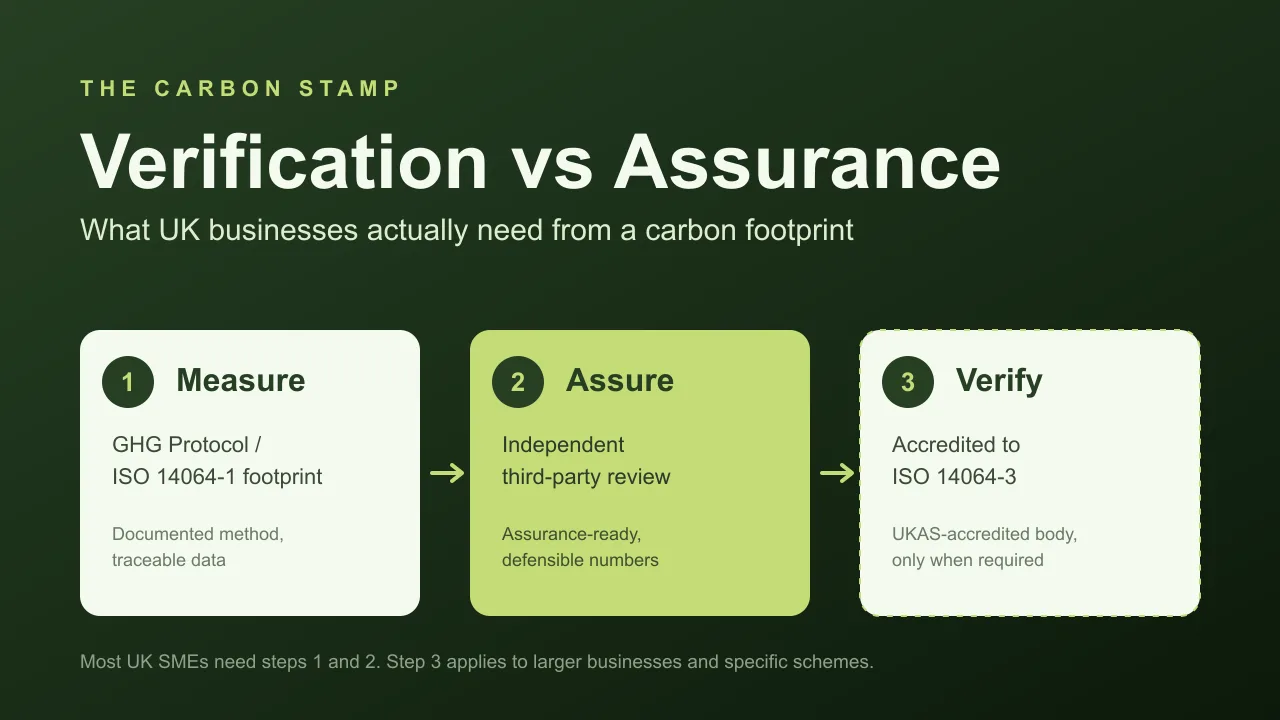
SECR's emphasis on methodology documentation, third-party verification options, and board-level accountability ensures that your carbon disclosures are audit-ready and defensible against greenwashing accusations. This credibility is critical for tender submissions, regulatory reviews, and stakeholder trust.
Need help aligning SECR with your Net Zero strategy? Our carbon reporting consultancy team provides expert guidance on integrating SECR with broader sustainability goals.
Frequently Asked Questions
Need help with your SECR report?
The Carbon Stamp provides expert carbon consultancy for UK businesses, from carbon footprinting to Carbon Reduction Plans, SECR reporting and ISO 14068 certification.