Fixed-fee pricing
Get your carbon assessment quote
View pricing →Table of Contents
If you bid for UK government contracts worth £5M+ per year, or supply the NHS at any value, you must submit a Carbon Reduction Plan (CRP) to comply with PPN 006. Without a compliant CRP, your tender is automatically excluded, regardless of price or quality.
This guide gives you everything you need: a complete section-by-section template walkthrough, a data collection checklist for Scope 1, 2, and 3 emissions, 12 common mistakes that lead to rejection, and a step-by-step 8-week compliance roadmap.
Whether you're creating your first CRP as an SME, updating an existing plan, or managing compliance for a large organisation, this guide covers everything in one place.
New to the policy? Start with our overview of what a PPN 006 Carbon Reduction Plan actually contains before working through the template below.
If you are using this template as a starting point, note that a consultant-prepared Carbon Reduction Plan, where the figures are calculated, verified and signed off on your behalf, typically costs £1,695+VAT for SMEs with 11–25 employees as a one-off fee. Larger businesses with 26–100 employees typically pay £2,195 to £3,195+VAT.
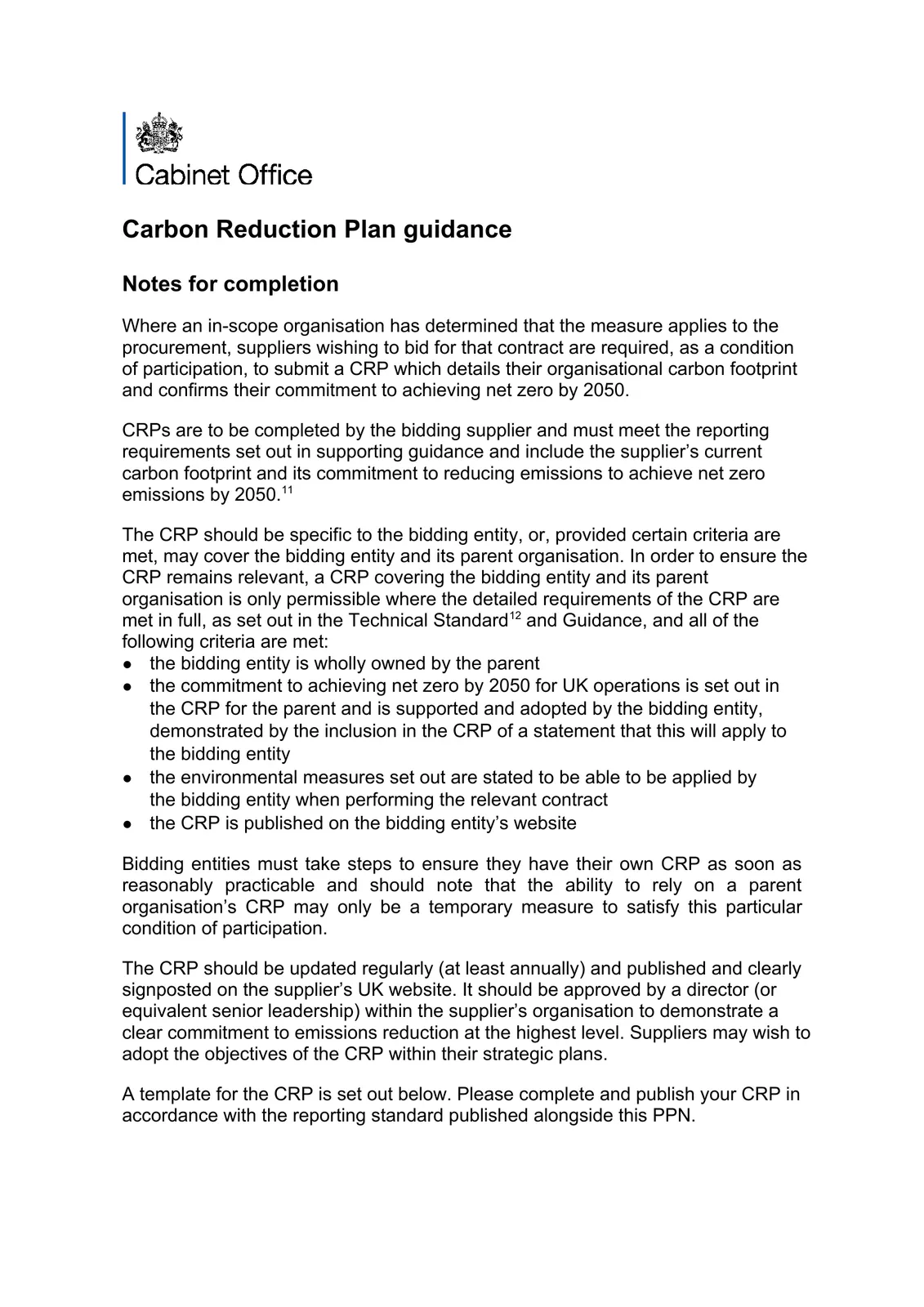
Get the template first
Work through this guide with the form open in front of you.
Official Annex A format, Word, no email required.
What Is PPN 006 and Who Must Comply?
PPN 006 (Procurement Policy Note 006) is the UK government policy requiring suppliers to major public sector contracts to submit a Carbon Reduction Plan demonstrating their commitment to Net Zero. It was introduced in 2021 as PPN 06/21 and renamed to PPN 006 in February 2025 under the Procurement Act 2023, the requirements are identical under both names.
For full policy background, see our complete PPN 006 explained guide. Sector-specific PPN 006 examples are available on our industry pages.
| Sector | Threshold | Net Zero Deadline |
|---|---|---|
| Central Government | £5M+ per year per contract | 2050 |
| NHS | All contract values (since April 2024) | 2045 |
| Local Government | Voluntary (recommended) | 2050 |
2026 Procurement Act Changes: From 1 January 2026, new procurement thresholds under the Procurement Act 2023 come into force. More contracts will fall in scope. Check now whether your contracts are affected, don't wait until a tender is imminent.
What Must Your CRP Contain? The Non-Negotiables
A compliant PPN 006 Carbon Reduction Plan must include seven mandatory sections. Missing any one is grounds for rejection.
1. Organisational Net Zero Commitment
A formal statement committing your organisation to Net Zero by 2050 (or 2045 for NHS contracts). This must include board or director-level sign-off.
Tip: Evaluators check this is a genuine commitment, not boilerplate. Vague language such as "we aim to be more sustainable" is a rejection risk. Be specific about your target year and scope.
2. Scope 1 Emissions Data
Scope 1 covers direct emissions from sources owned or controlled by your organisation, natural gas combustion, company-owned vehicles, on-site generators, and refrigerant leaks. Report in tonnes CO2 equivalent (tCO2e) using the latest DESNZ/DEFRA emission factors for your reference year.
3. Scope 2 Emissions Data
Scope 2 covers indirect emissions from purchased electricity, heat, steam, or cooling. You may use location-based or market-based accounting, note which method you've used. If you have a green energy tariff, you can use market-based accounting, but you must provide documentation (e.g. REGO certificates). Location-based reporting uses the UK grid average emission factor.
4. Five Mandatory Scope 3 Emissions Categories
The five Scope 3 categories mandated by PPN 006 are:
- Category 4: Upstream transportation and distribution
- Category 5: Waste generated in operations
- Category 6: Business travel
- Category 7: Employee commuting
- Category 9: Downstream transportation and distribution
Scope 3 is where most CRPs fail. These 5 categories are mandatory, skipping any one is grounds for rejection. For deeper guidance, see our Scope 3 emissions guide.
5. Emissions Reduction Targets
A minimum 5-year projection of your emissions reduction trajectory is required. Targets must be realistic, measurable, and expressed as a percentage reduction against your baseline year. Aligning your targets with the Science Based Targets initiative (SBTi) significantly strengthens your CRP and signals credibility to procurement evaluators.
6. Carbon Reduction Initiatives & Measures
Each initiative must include: the goal, timeline, expected emissions reduction (tCO2e), and a KPI. You need both current (already underway) and planned (future) measures. Examples include switching to LED lighting, electrifying fleet vehicles, moving to a renewable energy tariff, engaging suppliers on Scope 3 reduction, and pursuing ISO 14001 certification.
7. Director Sign-Off & Publication
The CRP must be signed by a named director (full legal name, job title, and date). It must also be publicly available on your UK company website before submission. CRPs without a named director signature are routinely rejected, sustainability manager sign-off is not sufficient.
PPN 006 Template Walkthrough: What to Actually Write in Each Section
The official PPN 006 template is available from gov.uk (Annex A). Here's exactly what to write in each section.
Template Section A, Company Details
Include: registered company name, Companies House number, registered UK address, and primary contact details.
Common mistake: Using your trading name instead of the registered company name as it appears on Companies House. These must match exactly.
Template Section B, Net Zero Commitment Statement
Example language you can adapt:
"[Company Name] commits to achieving Net Zero greenhouse gas emissions across our operations by [target year, no later than 2050]. This commitment is endorsed at director level and reflects our organisation's long-term strategy to reduce our environmental impact in line with the UK government's Net Zero target."
Evaluators check: Is it dated? Is it signed? Does it name a specific year? Is it genuinely specific to your organisation? Don't copy-paste from another company, procurement officers search for these statements online, and identical language across multiple submissions is a red flag.
Template Section C, Emissions Baseline
Present your baseline emissions in a table format. Use your most recent complete financial year. All figures must be in tCO2e (tonnes CO2 equivalent).
| Scope | Category | tCO2e |
|---|---|---|
| Scope 1 | Natural gas, company vehicles | [your figure] |
| Scope 2 | Purchased electricity | [your figure] |
| Scope 3 (Cat 4) | Upstream transport | [your figure] |
| Scope 3 (Cat 5) | Waste | [your figure] |
| Scope 3 (Cat 6) | Business travel | [your figure] |
| Scope 3 (Cat 7) | Employee commuting | [your figure] |
| Scope 3 (Cat 9) | Downstream distribution | [your figure] |
Common mistake: Reporting Scope 1 only and leaving Scope 2 and Scope 3 blank or as zero. This is grounds for immediate rejection.
Template Section D, Reduction Targets
Structure each target as: "By [year], we will reduce [Scope] emissions by [X%] against our [baseline year] baseline." A 5-year minimum projection is required. Example targets:
| Target year | Scope | Reduction vs baseline |
|---|---|---|
| 2027 | Scope 1 & 2 | 20% reduction |
| 2028 | Scope 3 (mandatory cats) | 15% reduction |
| 2030 | Total emissions | 50% reduction |
Template Section E, Carbon Reduction Initiatives
This is the most important section for standing out competitively. Each initiative needs four fields: Description, Timeline, Estimated CO2e reduction, and KPI.
| Initiative | Timeline | tCO2e saving | KPI |
|---|---|---|---|
| Switch to LED lighting across all sites | Q2 2026 | ~5 tCO2e/yr | % of sites converted |
| Electrify 50% of company fleet | 2027 | ~12 tCO2e/yr | % EV fleet |
| Move to 100% renewable energy tariff | Q1 2026 | ~30 tCO2e/yr | kWh from renewables |
| Supplier Scope 3 engagement programme | 2026–2028 | TBD | % suppliers with CRP |
| ISO 14001 environmental management certification | 2027 | Indirect | Certification achieved |
Template Section F, Environmental Management
List any existing environmental certifications (ISO 14001, Carbon Trust Standard, PAS 2060) and management systems. If you have none yet, "under consideration with target date of [year]" is acceptable, but be specific.
Template Section G, Director Attestation
Required fields: full legal name of director, job title, signature, and date. This section cannot be completed by a junior employee or sustainability manager, it must be a director-level signatory. The most common single reason for CRP rejection is an unsigned or incorrectly signed attestation.
Ready to fill it in? The official Annex A template is free to download, no email needed.
Download the free Carbon Reduction Plan templateHow to Collect Your Scope 1, 2, and 3 Emissions Data
Good data is the foundation of a credible CRP. Here's what you need to gather for each scope.
Scope 1 Data You Need
- Utility bills for natural gas (m³ or kWh, 12 months)
- Fleet fuel receipts or mileage logs (litres or miles by fuel type)
- Any on-site refrigerant top-ups (kg and type of refrigerant)
- Any on-site combustion equipment or generators
Scope 2 Data You Need
- Electricity invoices (kWh by location, 12 months)
- District heating or cooling purchases (if applicable)
- Green tariff documentation if claiming market-based accounting (REGO certificates)
Mandatory Scope 3 Data
- Upstream transport: supplier delivery invoices, freight distances, carrier reports
- Waste: waste transfer notes, tonnage by type (general, recycling, hazardous)
- Business travel: expense reports, flight bookings, hotel stays, rail tickets
- Employee commuting: staff commuting survey or postcode-distance estimates
- Downstream distribution: customer delivery data, logistics invoices, last-mile data
Free tools to calculate emissions:
- DESNZ/DEFRA conversion factors, free annual update from gov.uk (use the latest year)
- HMRC approved mileage rates for business travel
- GHG Protocol Corporate Standard and Scope 3 calculation tools
- Carbon Trust online footprint estimation tools
Don't have perfect data? Use estimates, and document your methodology. A well-explained estimate with a clear data source is acceptable. A blank field is not. For complex Scope 3 categories, our carbon consultants can build a defensible methodology in days rather than weeks. Once your CRP is published, residual emissions can be balanced through a verified carbon offsetting programme aligned with ISO 14068, but only after meaningful reduction work.
For employee commuting and home-working data, typically the weakest area in self-prepared CRPs, use our free Employee Carbon Survey to capture postcode-level commuting, mode-share and home-energy estimates in one round. See how Advanced Coated Products, a UK manufacturer, used a verified Scope 1, 2 and 3 footprint to deliver a board-signed PPN 006 CRP that supported their tender pipeline.
The 8-Step PPN 006 Compliance Roadmap
Most businesses take 4–8 weeks to create a compliant CRP. Here's a week-by-week plan.
- Week 1: Confirm Scope & Appoint an Owner. Check whether your contract value meets the PPN 006 threshold. Assign a named person responsible for CRP completion and secure director-level buy-in and commitment.
- Weeks 1–2, Collect Emissions Data. Pull 12 months of utility bills (gas, electricity). Gather fleet fuel records and mileage data. Survey employees on commuting patterns. Collect freight, waste, and business travel data.
- Week 2: Calculate Your Baseline. Use latest DESNZ/DEFRA emission factors for conversions. Calculate tCO2e for Scope 1, 2, and each Scope 3 category. Document your data sources and methodology.
- Week 3: Set Your Reduction Targets. Define your Net Zero year (no later than 2050; 2045 for NHS). Set 5-year interim milestones with % reductions. Consider SBTi alignment to strengthen credibility.
- Week 3: Define Your Reduction Initiatives. Brainstorm quick wins and long-term decarbonisation measures. Assign owners, timelines, and KPIs to each initiative. Gather input from relevant departments (facilities, fleet, procurement).
- Week 4: Complete the Official Template. Download latest version of the Annex A template from gov.uk. Fill all sections, leave no fields blank. Get legal or compliance review before sign-off.
- Week 4: Obtain Director Sign-Off. Book a board or exec meeting to present the CRP. Get a named director to sign with their full legal name and title. Date the document on the day of signing.
- Weeks 4–5, Publish, Submit, and Schedule Review. Upload to your company website in an easily findable location. Submit with your tender response. Set a calendar reminder for your annual update.
12 Most Common PPN 006 Mistakes (and How to Avoid Them)
Based on reviewing Carbon Reduction Plans across dozens of sectors, these are the errors that most commonly lead to rejection or non-compliance:
- Submitting a generic CSR statement instead of a CRP. A Carbon Reduction Plan is a specific compliance document with quantified emissions data, not a sustainability overview or marketing piece. Follow the Annex A structure.
- Missing the director sign-off. This is the most common reason for instant rejection. A named director (full legal name, job title, date) must sign. Sustainability manager sign-off is not accepted.
- Reporting Scope 3 incompletely. All five mandatory Scope 3 categories must be included. Partial data, even for one category, is flagged. Use estimates with documented methodology if exact data isn't available.
- Using an outdated template version. The PPN 006 template was updated in April 2025. Using the old PPN 06/21 template version may result in rejection. Always download the latest Annex A from gov.uk.
- Not publishing the CRP on your website. Your CRP must be publicly available on your company website before you submit it. Procurement officers check. A CRP submitted with a tender but not published online is non-compliant.
- Claiming zero emissions with no explanation. Zero-emission claims require evidence (e.g. fully electric fleet, certified offsets) or a clear roadmap. Blank zeros with no explanation are rejected.
- Setting vague targets. Targets like "we aim to reduce our carbon footprint" are insufficient. Targets must include: a specific percentage reduction, a named scope, and a target year.
- Using different emission factors without explanation. If you change emission factors between reporting years (e.g. DEFRA update), you must note and explain the change. Silent changes to the methodology undermine credibility.
- Forgetting to update annually. A CRP with emissions data more than 12 months old may be considered stale and affect ongoing contract evaluations. Set a calendar reminder and update every year.
- Misidentifying your Scope boundary. Including supplier emissions in Scope 1 (rather than Scope 3 Category 1) is a common methodological error. Scope 1 = only sources you own or control.
- Reporting in units other than tCO2e. All emissions must be reported in tonnes CO2 equivalent (tCO2e). Reporting in kWh, kg, or other units without conversion is non-compliant.
- Not aligning NHS CRPs with the 2045 deadline. NHS contracts require Net Zero by 2045, not 2050. Submitting a CRP with a 2050 commitment to an NHS tender is non-compliant.
PPN 006 for Different Sectors
PPN 006 applies across sectors, but each has specific nuances. Our sector-specific guides go deeper:
- NHS Suppliers: All contract values in scope since April 2024. Net Zero by 2045 deadline. Expanded Scope 3 requirements from April 2027. See our full NHS CRP guide.
- Construction: High Scope 3 complexity, subcontractor emissions, embodied carbon, National Highways requirements, and product-level footprinting. See our full construction guide.
- Professional Services: Lower Scope 1 and 2 footprints, but higher Scope 3 from business travel, employee commuting, and supply chain. Straightforward to create but must be evidence-based.
- Manufacturing & Supply Chain: Complex upstream transport and waste Scope 3 emissions. NHS suppliers in this sector face product-level footprinting requirements from 2028.
Keeping Your CRP Up to Date: The Annual Review Guide
A Carbon Reduction Plan is not a one-off document. It must be updated at least annually to remain compliant for ongoing contract evaluations and new tender submissions.
You should also update earlier if there are major operational changes: significant acquisitions, new sites, major supply chain restructuring, or new certifications achieved. Annual update checklist:
- Collect new 12 months of emissions data for all scopes
- Compare against previous year baseline and note the change
- Update targets if milestones have been met or require revision
- Add newly completed initiatives plus new planned ones
- Update director sign-off with new date (signature must be fresh)
- Replace the published version on your company website
- Update submission documents for any live contracts
NHS suppliers: prepare now for April 2027. From April 2027, NHS suppliers must publish emissions targets and data for all Scope 3 categories globally, not just the five mandatory ones. If you're an NHS supplier, start building your broader Scope 3 data collection processes now to avoid a last-minute scramble.
Frequently Asked Questions About PPN 006
Need a Carbon Reduction Plan for your business?
Need a PPN 006 Carbon Reduction Plan to win UK public sector tenders? The Carbon Stamp delivers compliant, board-signed CRPs aligned to GHG Protocol and NHS Net Zero requirements.