Fixed-fee pricing
Get your carbon assessment quote
View pricing →Table of Contents
You can estimate your business carbon footprint for free in a few minutes, and for most first-time requests from a client, a bank or a tender panel, that is exactly the right place to start. The number will not be perfect, and it should not be treated as one. But it is a genuinely useful first figure, provided you understand exactly what it does and does not cover.
This guide walks through what you need to gather, how to turn it into a number using our free calculator, where a free estimate stops being good enough, and exactly when you need a verified Carbon Impact Report instead.
What a free estimate actually gets you
A free carbon footprint estimate is a screening-level figure. It uses the data you already have, an energy bill, a rough headcount, an idea of how the team travels, run through standard UK Government conversion factors, to produce a total in tonnes of CO2 equivalent (tCO2e) across Scopes 1, 2 and 3.
It tells you the scale of your footprint and where most of it sits. What it does not do is stand up to independent scrutiny: nobody outside your business has checked it, and parts of it, particularly some Scope 3 categories, are usually estimated rather than measured. A verified Carbon Impact Report starts from the same scopes but replaces estimates with your actual activity data wherever possible, and has a consultant behind the number who can defend it. If you are new to what Scopes 1, 2 and 3 actually mean, our guide to business carbon footprints covers the fundamentals first.
| Free estimate | Verified Carbon Impact Report | |
|---|---|---|
| Scope coverage | Scopes 1, 2 and the Scope 3 categories a short questionnaire can capture | Scopes 1, 2 and 3, scoped to what is material to your business |
| Data source | The figures you enter, run through standard averages | Your actual activity data: bills, receipts, supplier records |
| Who checks it | Nobody, it is self-serve | A carbon consultant, who puts their name behind the figure |
| Turnaround | A few minutes | Four to eight weeks |
| Use case | Internal planning, a first conversation, working out where to focus | Tenders, NHS supply, verified disclosures, investor due diligence |
What you need to gather before you start
Whether you use a spreadsheet or a guided tool, the underlying data is the same. Have these ready and the whole thing takes a few minutes rather than a few hours:
- Heating fuel. Mains gas, oil, LPG or electric-only, and roughly how much you use a year, your annual bill has this. This is a direct, Scope 1 emission, so it carries more weight in the total than a rougher estimate would.
- Electricity usage. Annual kWh from your bill, or your floor area if you do not have it to hand. This is your Scope 2 figure, and it is usually the easiest number to get exactly right.
- Company vehicles. Any cars, vans or HGVs your business owns or leases, and roughly how much fuel they use. Fuel use converts directly to emissions, so even a rough annual mileage is more useful than a guess at litres.
- Business travel. Whether anyone flies for work, and roughly how many trips a year. Flights are a small number of journeys but a disproportionate share of most footprints, so this one is worth getting right even as an estimate.
- Commuting. How your team mostly gets to work: office-based, hybrid or remote, and a typical journey. This is often the largest Scope 3 category for office-based businesses, so it moves the total more than people expect.
- Waste. A rough sense of how much general waste you produce, from a few bins a week to skips. It is usually a small slice of the total, but it is one reviewers specifically check has not been left out.
None of this needs to be exact. A reasonable estimate for each is enough to get a useful first figure, and you can always come back and refine it later.
How to do it in a few minutes with our free calculator
We built a free carbon footprint calculator that turns exactly this data into an estimate, without a spreadsheet or a login. Answer the questions above and it gives you a total in tCO2e across Scopes 1, 2 and 3, your three biggest emissions hotspots, a personalised set of actions to start reducing them, and a CSV export of the full breakdown if you want to keep a record or hand it to someone else.
Start your free estimate
Seven quick questions on energy, vehicles and travel. Most people finish in under five minutes.
Free, no login required. You will be asked for your email to see the full result.
Where a free estimate falls short
A free estimate is built to be fast, not audit-grade, and it is worth being honest about where that trade-off shows up. Some Scope 3 categories, purchased goods and services, capital goods, leased assets, are difficult to estimate from a short questionnaire and are usually left out or roughly approximated rather than properly captured. The figures behind it are averages and benchmarks rather than your actual metered data, so two businesses with very different real footprints can come out with similar numbers if their answers are similar. And nobody outside your business has checked it: there is no assurance statement, no methodology write-up, and no consultant who can answer a procurement team's follow-up questions.
None of that makes it useless. It makes it exactly what it says it is: a starting point. Our guide to carbon footprint assessment costs covers what changes once you move from a free estimate to a full assessment, and what UK SMEs typically pay for one.
When you actually need a verified Carbon Impact Report
A free estimate is enough when the number is for your own planning: an internal target, a first conversation with a client, working out where to focus. It stops being enough the moment someone else needs to rely on it. In practice, that usually means one of the following:
- Bidding on a UK government contract. Above the £5 million threshold, PPN 006 requires a Carbon Reduction Plan built on real data, not a self-serve estimate.
- Supplying the NHS. NHS suppliers face their own Net Zero and Carbon Reduction Plan requirements, and reviewers are used to seeing what a properly measured footprint looks like.
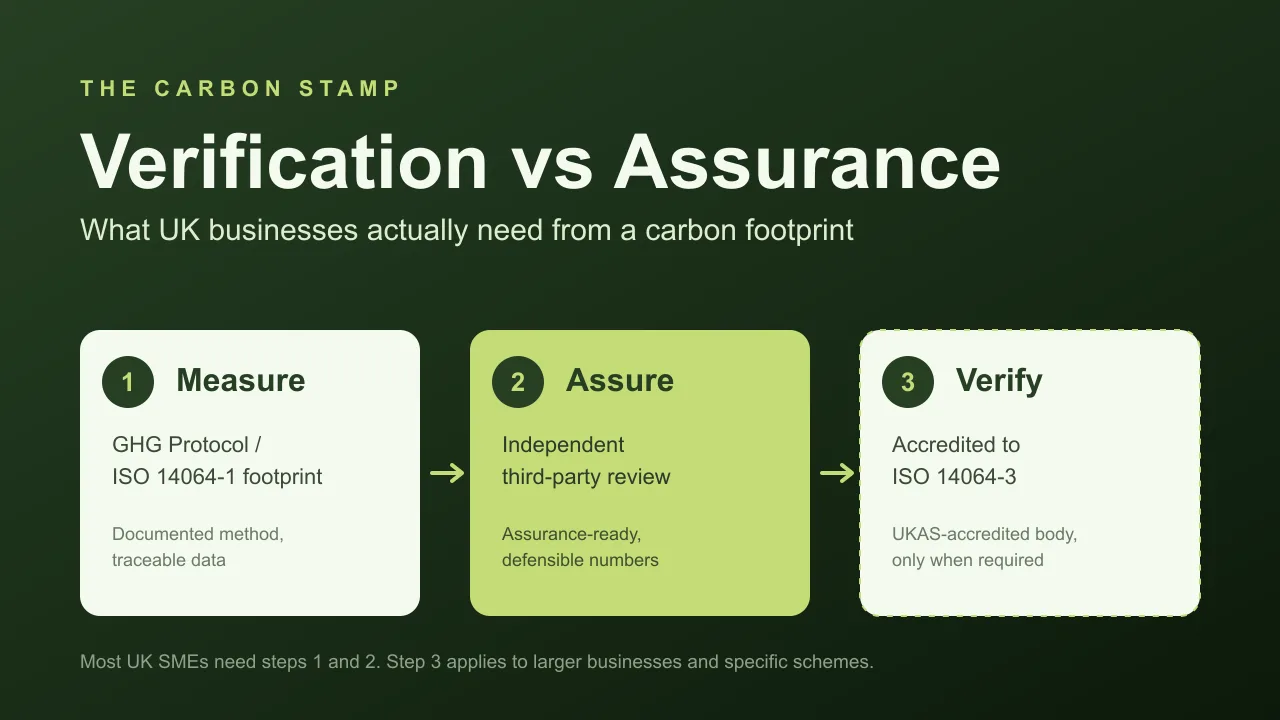
- A client or funder has asked directly. If the request came with the word verified, assured or third-party checked in it, a free estimate will not satisfy it. Our guide to carbon footprint verification vs assurance explains which one those requests usually mean.
- You are reporting under SECR or preparing for investor due diligence. Both expect a defensible methodology behind the number, not a benchmark-based guess.
If any of those sound familiar, the next step is a Carbon Footprint Assessment, where a consultant works from your actual data rather than averages and puts their name behind the figure.
Frequently asked questions
Want a carbon footprint number you can actually put in a tender?
The Carbon Stamp provides expert carbon consultancy for UK businesses, from carbon footprinting to Carbon Reduction Plans, SECR reporting and ISO 14068 certification.